CenterPoint Energy

Outage Tracker

CenterPoint Energy

Vegetation Management

CenterPoint Energy

Outage Tracker

CenterPoint Energy

Vegetation Management

Challenge


Challenge


In 2024, Hurricane Beryl struck the Houston area and left hundreds of thousands of residents without power — many for multiple days, and some for a week. With extreme heat and limited visibility into restoration timelines, frustration escalated quickly. Customers questioned whether CenterPoint was prepared, and the company’s credibility took a visible hit.


CenterPoint responded operationally by launching the Greater Houston Resiliency Initiative, a multi-year effort to strengthen the system ahead of future storms. But Leadership understood a hard truth: doing the work isn’t enough. If customers can’t see it, measure it, or understand it, trust doesn’t recover. CenterPoint needed communications that were specific and factual so customers could clearly understand what was changing and why it mattered.

In 2024, Hurricane Beryl struck the Houston area and left hundreds of thousands of residents without power — many for multiple days, and some for a week. With extreme heat and limited visibility into restoration timelines, frustration escalated quickly. Customers questioned whether CenterPoint was prepared, and the company’s credibility took a visible hit.


CenterPoint responded operationally by launching the Greater Houston Resiliency Initiative, a multi-year effort to strengthen the system ahead of future storms. But Leadership understood a hard truth: doing the work isn’t enough. If customers can’t see it, measure it, or understand it, trust doesn’t recover. CenterPoint needed communications that were specific and factual so customers could clearly understand what was changing and why it mattered.

Wildfire preparedness has long been a critical issue in California, and longstanding gaps in outreach remain. PG&E’s Community Wildfire Safety Program campaign reinforced how seniors — especially within Latino families — as well as individuals with access and functional needs, continue to be disproportionately vulnerable and underserved by traditional messaging.


News stories highlighted seniors struggling with basic emergency readiness, from navigating outages to understanding evacuation guidance. At the same time, many Latino families live in the wildland-urban interface, where wildfire risk is highest. Yet preparedness communications often relied on fear-based messaging or technical language that felt impersonal, inaccessible, or culturally disconnected.


PG&E needed to deliver critical preparedness information without frightening or alienating audiences — and in a way that resonated emotionally across both English- and Spanish-speaking households.

Insight

After a crisis, customers aren’t looking for lofty brand language. They want proof that things are going to be different moving forward. The most credible message wasn’t “a better tomorrow”; it was concrete information about what’s being built, how it works, and what it changes during the next outage. Prove It Media’s challenge was to translate these complex operational changes into simple, trustworthy messaging. We needed real information communicated at a volume that would allow for testing, learning, and optimization.

Idea

Make resilience tangible: keep it simple, show the work, name the investments, and let facts do the persuading. Don’t overpromise.

Solution

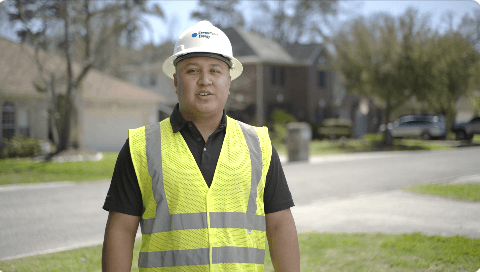
We partnered with CenterPoint to build a high-volume campaign that communicated CenterPoint’s progress through clear, repeatable proof points anchored in workforce and field work — not corporate messaging. We produced 14 executions in both English and Spanish, designed to rotate in-market and prevent creative fatigue while enabling optimization. Each spot focused on a distinct initiative customers could understand and believe: stronger poles, vegetation management, weather stations, a self-healing grid using automated devices, a training academy to build the future workforce, and customer-facing tools like the outage tracker and Power Alert Service. The approach emphasized both specificity and restraint, informing customers what CenterPoint was doing, without promising outcomes the grid can’t guarantee. The campaign ran across broadcast TV, radio, and digital, with multiple creatives live at once (often 8 – 10 at a time) to test performance and continuously optimize.

Results

Results

The campaign generated over 38 million impressions, resulting in an estimated total reach of approximately 4.42 million unique people

Strong view-through performance: ~75% average completion rate across video placements

High-performing engagement on Meta (0.95% CTR) and Native placements (0.25%)

Luma

Hurricane Safety

Luma

Hurricane Safety

Copyright ©

2026

|

designed & Developed by Prove It Media

Copyright ©

2026

|

designed & Developed by Prove It Media